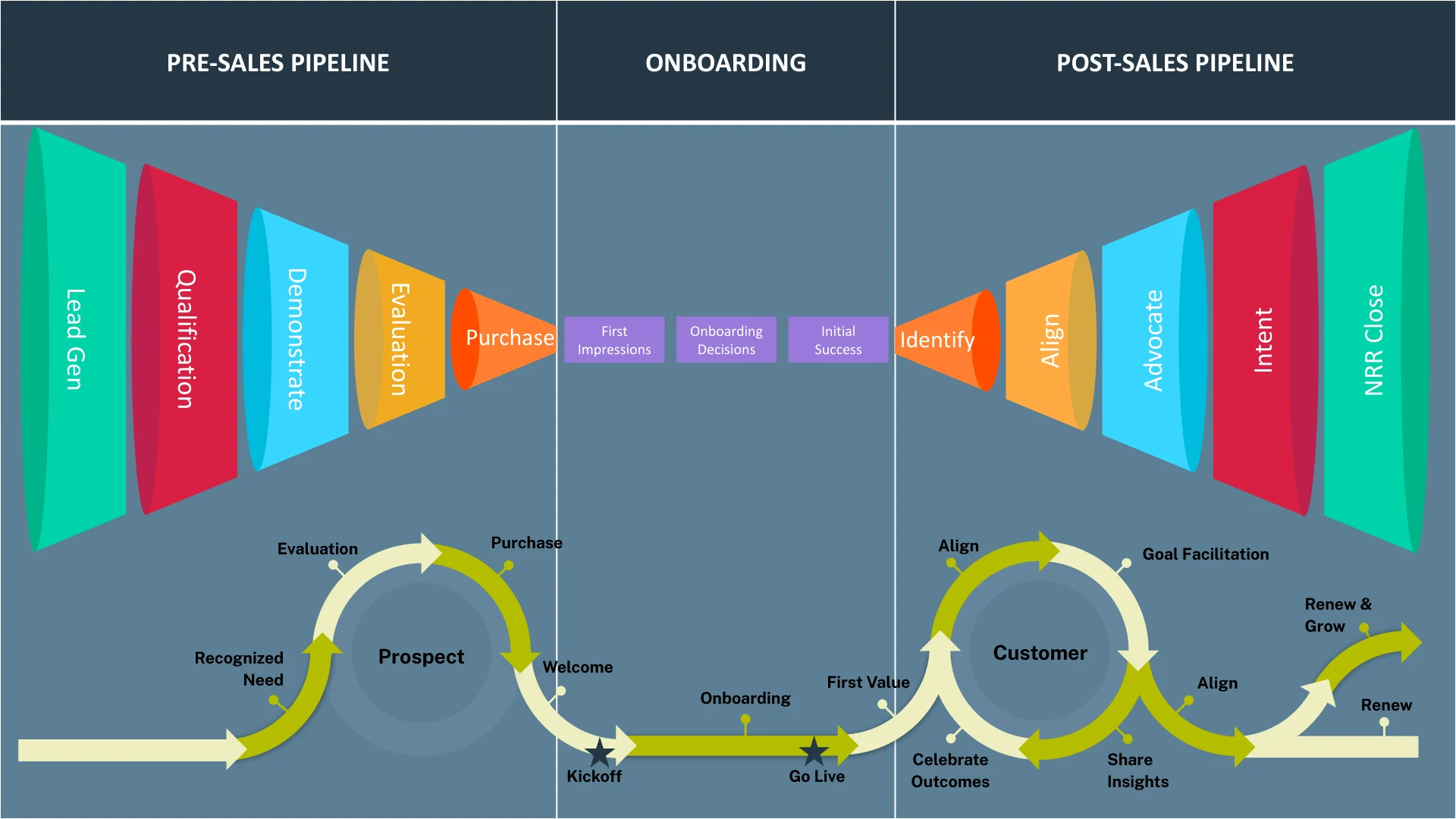
Part I established that retention behaves like a pipeline: customer progression can be designed, inspected, and managed, and the revenue it supports can be seen and forecast. Part II makes that pipeline concrete. It defines the five stages of Identify, Align, Advocate, Intent, and Net Revenue Close, and the evidence each one requires for an opportunity to advance. One distinction runs through all of it: customers don't move through the pipeline. Revenue opportunities do.
For a standalone summary of the model, see What Is a Post-Sale Pipeline?
Before the chapters that follow unpack each stage, three ideas need to be established clearly. They are the operating logic of the pipeline, and they will shape how every stage, every play, and every probability weight should be understood.
The plays serve the customer, not the pipeline.
The lifecycle plays exist because customers need them. Purchase & Welcome, Kickoff, Onboarding, First Value, Value Blocks, Sharing Insights, Alignment Meetings, and Renew & Grow all guide the customer from the moment of purchase toward the outcomes they bought. They create alignment, build confidence, deliver evidence of progress, and deepen the relationship over time. The plays are the operating work of Customer Success.
The pipeline reads from that work, but it is not moved by it. A play is what the company does. Progression is what changes with the customer. Evidence tells whether the required change occurred. The pipeline translates that evidence into a revenue view. When the evidence satisfies the exit criteria for an opportunity's next stage, the stage changes, the probability updates, and the forecast updates. A play that runs without producing its intended change creates no evidence, so it moves nothing. The plays are not performed for the pipeline. The pipeline reads the evidence they help create.
This is exactly how a sales pipeline works. A sales rep does not hold a discovery call in order to move a deal from Stage 1 to Stage 2. The rep holds the call because the prospect needs it. The deal advances when the call surfaces what the next stage requires. The same logic applies here. The CSM runs the play because the customer needs it. The pipeline records what the evidence shows.
The renewal is the first opportunity in the pipeline. Expansion opportunities join it.
This distinction matters because it defines how the post-sale pipeline creates revenue, and how the two kinds of revenue move through the same stages differently.
Every customer creates a renewal opportunity at purchase. The renewal exists from day one. It carries a known close date: the end of the contract. Its value is the current ARR up for renewal. It is the floor. It does not need a separate sales motion, because the lifecycle plays do most of the work that supports it. But it is held to the same evidence standard as any other opportunity. In the first term, it stays in Identify until the customer reaches First Value. Value Blocks create evidence of progress. Alignment Meetings keep the relationship pointed at the right outcomes and build the internal support the renewal needs. Renew & Grow brings the accumulated evidence together and surfaces the customer's commitment. The renewal advances only as that evidence meets each stage's criteria, and it reaches Intent only when the customer says yes. The pipeline shows exactly where it stands.
Expansion opportunities are different. They are new revenue. An upsell identified during a Sharing Insights play. A cross-sell that surfaces in an Alignment Meeting. A new business unit that appears when a champion introduces a peer. Each of these is a distinct opportunity that enters the pipeline at Identify once it is specific enough to manage and moves through Align, Advocate, Intent, and Net Revenue Close on the strength of its own evidence.
Speed is not a property of the opportunity type. It is a property of how much of the required evidence already exists. A first-term renewal is often the slowest opportunity in the pipeline, because it has to earn every stage, starting with First Value. A repeat-cycle renewal often moves quickly, because it inherits what the relationship has already built. Alignment, advocates, and evidence carry forward, and the early exit criteria are often met quickly. Expansion opportunities move at whatever pace the account's existing conditions allow.
A single customer may have one renewal and two or three expansion opportunities moving through the pipeline at once, each in its own stage. The renewal is the floor. The expansion opportunities are the growth. The pipeline tracks both. Evidence advances both.
Probability weights are set per stage. What varies is the work required to earn them.
Each stage carries a default probability: Identify 20%, Align 40%, Advocate 60%, Intent 90%, and Net Revenue Close 100%. These are standardized forecasting assumptions tied to increasing levels of commercial evidence, not measured close rates. The model stays simple because the math does not change by customer tier, segment, or complexity. An opportunity in Align carries the same weight whether it belongs to a high-touch enterprise customer or a digital SMB customer. The difference is operational, not mathematical. A high-touch customer may need a formal Alignment Meeting with executive stakeholders to produce the evidence. A low-touch customer may produce it through a self-service milestone or an automated check-in. The plays change. The stages do not. The probabilities do not.
This is what makes the model defensible to a CRO. The pipeline is not a custom scoring system that needs to be explained differently for every segment. It is a shared structure with consistent definitions and consistent math, delivered through segment-appropriate motions.
The pipeline also moves in both directions. An opportunity sits at the highest stage its current evidence supports. When an advocate leaves, a priority changes, or a commitment is withdrawn, the opportunity moves back to the stage its remaining evidence supports. Retention opportunities never drop out early. Each one ends at Net Revenue Close with what actually happened, including a reduced renewal or a loss.
The chapters that follow make the pipeline concrete. They move through the five stages in order, from Identify through Net Revenue Close, and define the evidence each one requires for an opportunity to advance. Every stage follows the same rule: the stage is not determined by what the team did. It is determined by what the team can prove about the opportunity. Plays help create that evidence. In the early stages, much of it comes from customer progression. In the later stages, it comes from internal advocacy, an explicit commitment, and finally the completed close. When the evidence meets the next stage's exit criteria, the stage changes, the probability updates, and the forecast updates.
As the stages progress, the relationship deepens. Early chapters focus on the foundational work: confirming the reason for purchase, guiding the customer toward First Value, and establishing the evidence that the solution is creating real progress. Later chapters explore how that evidence becomes organizational momentum, how momentum converts into commercial intent, and how intent becomes closed revenue. Along the way, expansion opportunities surface naturally, not because the team is hunting for upsells, but because the plays are creating the conditions where growth becomes the customer's own next logical step.
The goal is not to add a forecasting layer on top of Customer Success. It is to show that the post-sale work the company already does, when designed well and its evidence captured consistently, is the forecasting layer. The pipeline does not require new data. It requires the discipline to capture the evidence the work is already producing.
For a focused walkthrough of how the pipeline turns customer progression into a revenue forecast, see How Do You Make Existing-Customer Revenue More Predictable?